In a recent discussion with Revisor, Alpha Vee founder Leigh Eichel and Chief Investment Officer Ethan Dunbar dive into how Alpha Vee’s systematic strategies solve core portfolio challenges for financial advisors.
Alpha Vee has been named by the Texas Stock Exchange (TXSE) among the index providers whose methodologies feature TXSE-listed securities, marking an important milestone in Alpha Vee’s continued presence within the global indexing ecosystem.
In its September 2026 press release, TXSE announced that major index providers have updated their methodologies to support securities listed on the Texas Stock Exchange. Alpha Vee was specifically included among the index providers supporting TXSE-listed securities, alongside leading global firms including S&P Dow Jones Indices, MSCI, FTSE Russell, Nasdaq, Solactive, and others.
The announcement highlights Alpha Vee’s role in an evolving U.S. capital-markets landscape and reinforces the company’s position as an established provider of innovative index solutions. As new listing venues such as TXSE expand investor and issuer choice, Alpha Vee continues to develop index methodologies designed to adapt to the changing structure of global financial markets.
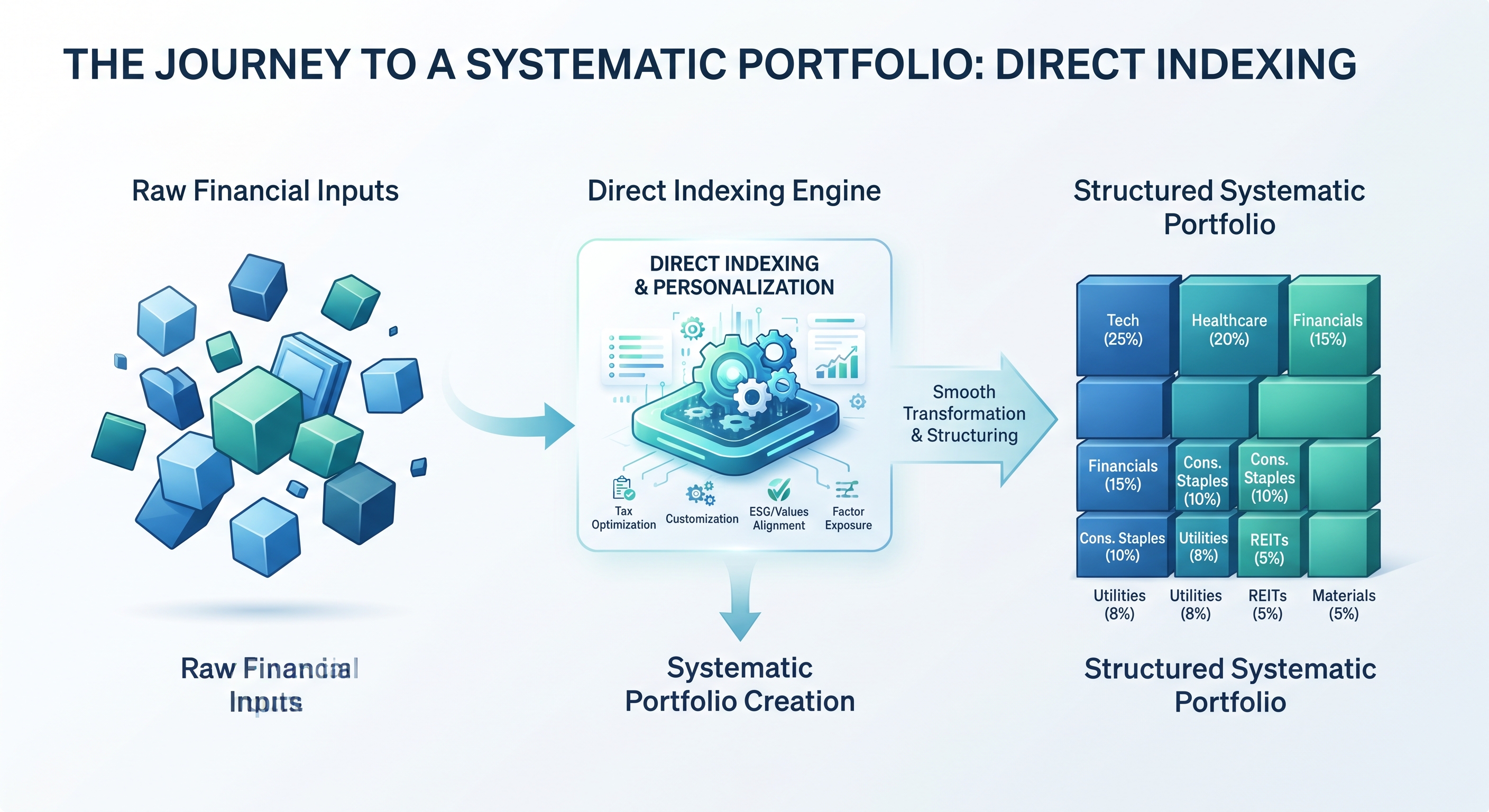
Advisors frequently inherit client portfolios loaded with embedded capital gains from legacy stocks, concentrated positions, or underperforming SMAs. Liquidating these assets entirely triggers an immediate, costly tax bill. The Alpha Vee direct indexing approach solves this by transitioning portfolios in-kind, allowing existing holdings to transfer directly into a rules-based strategy without immediate conversion to cash. Advisors can choose from Tax-First, Balanced, or Tracking-First paths to balance tax costs against tracking error. This method delivers tax alpha, lowers transaction costs, defers gains, and provides ongoing tax-loss harvesting within a customized, systematic framework.
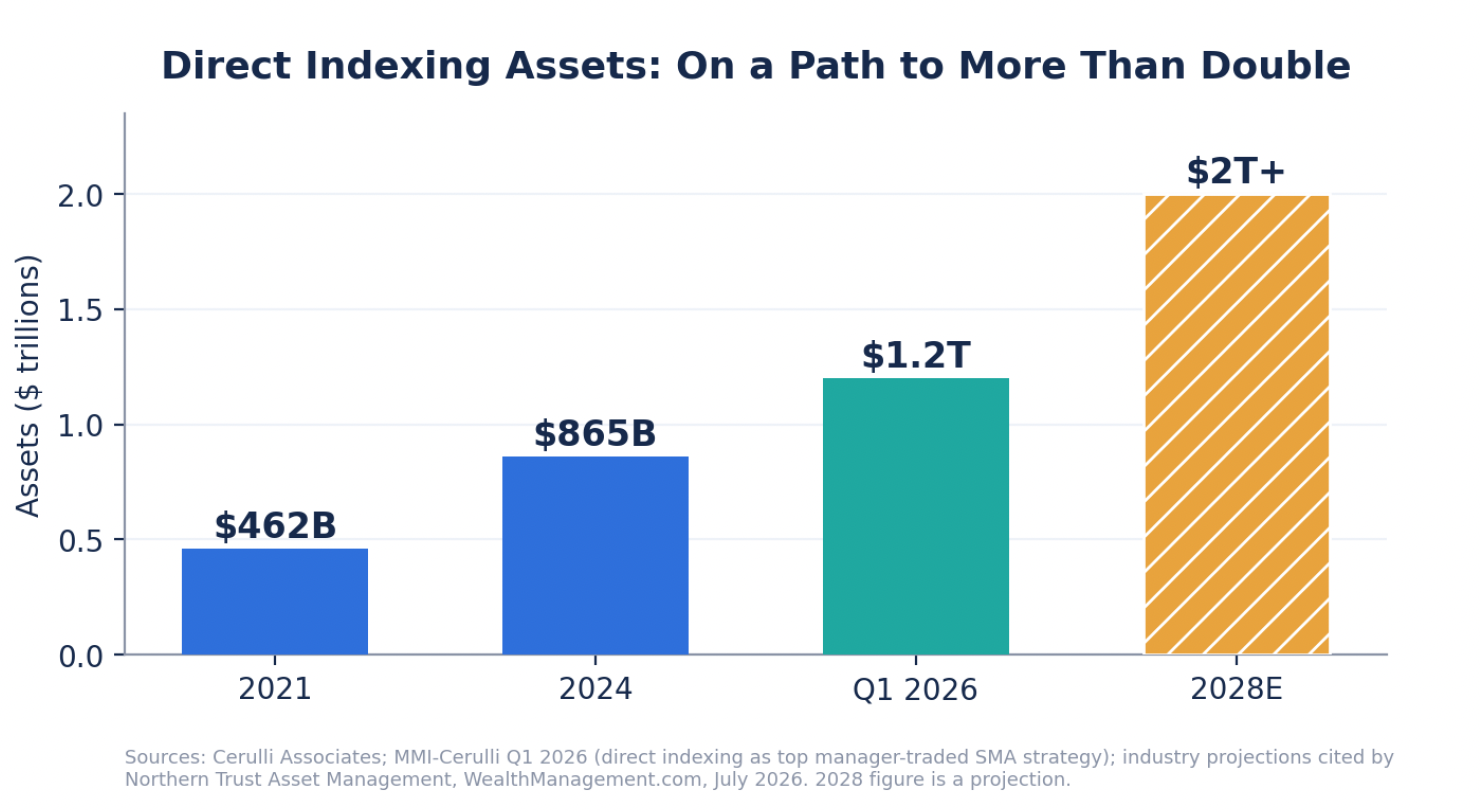
The fastest-growing corner of wealth management isn't a new fund. It's the decision to stop using funds. Direct indexing — owning the individual securities that make up an index inside a separately managed account — closed 2024 with $865 billion in assets, nearly double its 2021 level, and industry projections put it on a path past $2 trillion by 2028.

Ask five advisors what direct indexing involves day to day, and the answers tend to diverge fast—even as the marketing pitch stays consistent: tax alpha, customization, differentiation. In a recent conversation with The Wealth Advisor’s Scott Martin, Leigh Eichel, Alpha Vee Solutions Co-Founder and CEO, and Tanner Dallas, Partner and Investment Advisor at OPG Advisors, closed that gap with specifics, walking through what Eichel calls “next-level direct indexing”: a model-portfolio approach that treats individual direct indexes as building blocks rather than standalone strategies.

Alpha Vee Solutions sits at the center of the direct indexing movement—a financial technology firm whose portfolio infrastructure aims to make personalized, tax-efficient investing accessible at scale, not just for institutional players but for independent advisors and the clients they serve every day.

Where many firms layer risk management on top of existing strategies, Alpha Vee builds portfolios with risk considerations embedded at every level. “So, what makes us different? The risk management, the methodology, and the technology”.
In an ever-evolving financial landscape characterized by the rise of efficiency, personalization, and risk management, Alpha Vee Solutions has emerged as a pioneering force. With a robust foundation in global equity research and software engineering, Alpha Vee is uniquely positioned to serve modern financial professionals who are looking to navigate the complexities of direct indexing.
Disciplined Growth + Dynamic Risk Management + International DIversification
In conversation with The Wealth Advisor, Eichel outlined how Alpha Vee’s approach to dynamic risk management aims to address the fundamental challenge advisors face—keeping clients invested through volatility while managing downside exposure.

Simplifying Complexity: Alpha Vee Workstation Powers Virtue Capital Management’s Innovative Strategy Research and Selection Platform

Building on Momentum: Alpha Vee Workstation Helps Symmetry Partners Develop Unique SMA Strategies

Alpha Vee Solutions offers a comprehensive solution for advisors seeking a dynamic, research-driven, and customizable approach to portfolio management. Its commitment to technology, transparency, and innovation positions the firm as a valuable partner in the ever-evolving landscape of wealth management. As advisors grapple with the challenges and opportunities of today’s markets, Alpha Vee’s offerings deliver a way to enhance client outcomes while navigating market complexities.
Leigh Eichel’s portfolios often rank near the top of the industry performance rankings. Here’s how he does it.
The newest innovation in asset management. SMA/UMA technology now affords investors Direct access to personalized baskets of securities.Lower cost | Customized | Tax Alpha.Our strategies, customized or off-the-shelf, are designed for advisors looking for investment strategies on various TurnKey-Asset- Management Platforms (TAMPs).
Alpha Vee CEO Leigh Eichel explains how their platform uses AI, deep fundamental and quantitative research, custom direct indexing and risk-management tools to deliver innovative portfolio strategies.
Combining fundamental and quantitative research to multi-asset model portfolios in a very innovative way. This can deliver portfolios that help accomplish some of the most time-consuming tasks for investment managers.
Soft landing or bumpy road?
A strategy to empower you with unique investment research that combines the potential for solid returns with prudent systematic risk managementCombining fundamental and quantitative research to multi-asset model portfolios in a very innovative way. This can deliver portfolios that help accomplish some of the most time-consuming tasks for investment managers.
In this special episode of the NAAIM Confidential Podcast, host Ryan Redfern with Shadowridge Asset Management welcomes speaker Leigh Eichel from Alpha Vee Solutions for an insightful conversation. Join them as they dive into exclusive investment insights and discuss strategies to navigate today’s complex financial markets.

Leigh Eichel and Ayal Bahary at Alpha Vee recently provided an overview of their investment models. Now's your chance to get a look behind the scenes.

SMID caps are generally less covered by analysts, less liquid, and generally more volatile in the short and medium term than large caps.
Large-cap companies, the giants of the corporate world, hold the key to enduring financial prosperity.
Alpha Vee's CEO, Leigh Eichel, presents our risk managed strategies
Alpha Vee’s CEO Leigh Eichel interviews with Scot Martin, the editor of The Wealth Advisor, for the Portfolio and Strategists Spotlight.
Fundamental driven variable portfolio allocations using US Treasuries can offer several benefits compared to traditional rigid fixed 60 40 allocation models.

Just a quick note from Alpha Vee . . . the fixed income allocation on their risk managed strategies is pivoting to better cope with real rates.

Alpha Vee Risk Managed Top 5 Sector ETFs & Treasuries Index nominated as finalist in the Direct Index of the Year category.

This offering enables Smartleaf clients to provide their clients with radically lower-priced alternatives to actively managed models and cost-competitive alternatives to ETFs and mutual funds.
Designed to capture the accelerating global shift toward cleaner, more efficient, more sustainable mobility, energy production and transmission

Our results weren't pure Magic Formula but they outperformed the S&P 500 over a 10-year period. However, the smart beta approach can still be refined.

Using the right system for controlling risk can enhance returns while minimizing the volatility for the investor. But first you need clarity.

The small- and mid-cap universe has become a little impenetrable in recent years but clients will welcome the chance to capture better growth profiles
Moshik Kovarsky met with Julie Cooling, Founder & CEO, RIA Channelto discuss his fundamental momentum strategy.

Mr. Market has been in a volatile mood since we last analyzed his mood swings and offered a potential solution based on Fundamental Momentum. Indeed, his volatility ruled the first quarter of 2018. The Fundamental Momentum indicator anticipated this well and provided warning signs as early as mid-February 2018.
But what can we do about Mr. Market’s split personality?
Some sectors are stable and calm while others are jumpy and nervous. The reasons may be fundamental in nature, or they may be due to singular events. The recent Facebook debacle is a prime example. One company’s tribulations affected the whole sector. Even advocates of fundamental analysis must admit that the governing fundamentals for each sector can vary considerably.

“Management is doing things right; leadership is doing the right things.”
The legendary management consultant, educator, and author Peter Drucker helped coin this now well-known phrase. And since we all want to be investment leaders rather than mere investment managers, we should look for ways of doing the right things for our portfolios.
That’s where sector priority comes into play. Our crazy Mr. Market, with his mood swings and split personality, does have a sense of priority, though it’s often misunderstood. He favors different sectors at different times.
The question is: How do we decipher what Mr. Market’s priorities are at any given moment?

As Graham saw it, whenever you invest in the stock market, you partner with the moody Mr. Market. Each day he offers you a choice: sell to him, buy from him, or do nothing. His daily mood determines the price that he is willing to offer or accept, and it is up to you alone to decide what to do.

Over the last decade, the Smart Beta ETF industry has become one of the most exciting investment trends. With more than 1000 ETFs, managing above $800B in the US alone, new tools must be constantly developed to improve performance, reduce volatility and control risk. We, at Alpha Vee, have been leading the development and refining unique dynamic strategies using fundamental global indicators. These indicators have been proven and have provided significant advantages for smart beta ETFs. The indicators, based on a large body of historical data, provide grading for the market as a whole as well as for individual sectors. When added to a solid multi-sector-multi-factor (MSMF) strategy, the result is compelling. In this paper we will review such an index and dissect its performance over the last 3 years, through various market up and down events.

Risk is an inherent part of our life. In the immortal words of President Theodore Roosevelt: “Risk is like fire: if controlled it will help you; if uncontrolled it will rise up and destroy you.” In the world of investments, taking risks is a prerequisite for achieving returns, and controlling the risk is the key for a successful investment.

Market risk is undoubtedly the most significant risk component for the equity investor. When the market falls, almost everything dives with it. When it rises, it pulls up some bad apples as well. The savvy investor should recognize this reality and act according to the famous quote by Warren Buffett: “look at market fluctuations as your friend rather than your enemy”. Naturally, this is easier said than done, but with recently introduced data driven tools, this daunting task can become more manageable and disciplined.

Sector allocation as a risk is often ignored by the novice investor. The lack of adequate tools in the past has caused many investors to look at the market as a whole or to pick and choose individual stocks. What was often neglected is the tendency of stocks within the same sector to move in unison. Overweighting a declining sector or underweighting the one on the rise (done implicitly by choosing specific stocks) can adversely affect the portfolio. The alternative of using sector funds carries the risk of owning the wrong fund at the wrong time, adds trading and tax costs and may hinder the performance as well.

Stock Selection risk can be defined as the probability that the return of a portfolio composed of individual stocks will be worse from an expected benchmark. Historically, this type of risk has been the one most commonly considered by investors. Modern investment tools, such as ETFs that follow the benchmark index, can now neuter this risk and let the investor concentrate on sector and market risks only (discussed in previous articles in this series).
Alpha Vee combines deep industry expertise with actionable insights to help you overcome challenges, save money, and drive business growth. Our integrated software and investment strategies let you focus on alpha-generating ideas and serving your clients.
Disclosure: Investing contains substantial risk and is not for every investor. An investor could potentially lose all or more than the initial investment. Risk capital is money that can be lost without jeopardizing one's financial security or life style. Only risk capital should be used for trading and only those with sufficient risk capital should consider trading. Past performance is not necessarily indicative of future results.